Last year, Marion County Middle School Library Media Specialist Cheryl May applied for and received a grant through the Marion County Education Foundation to purchase a set of small remote controlled drones.
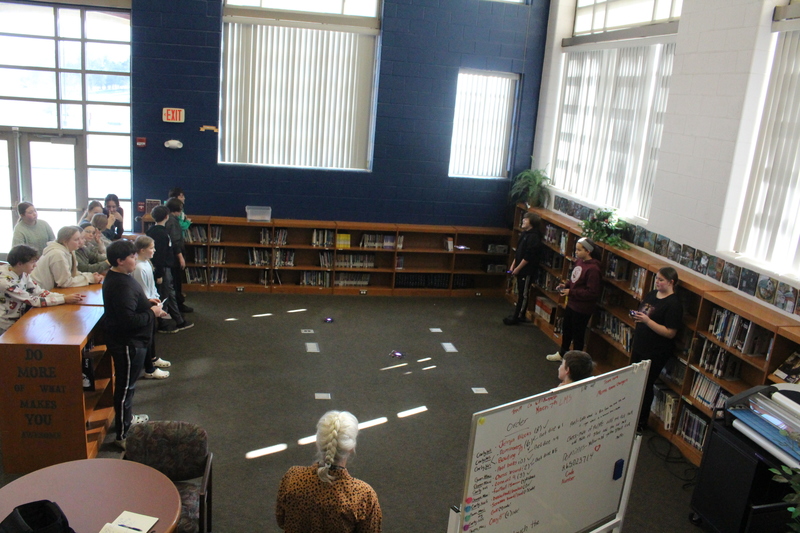
Recently, students at MCMS got their first attempt at operating the drones in the school’s library during WIN (What I Need) time. However, it wasn’t simply a chance to fly a remote controlled toy; instead, May turned it into a lesson on non-verbal communication to go along with learning a host of aviation-related terminology.
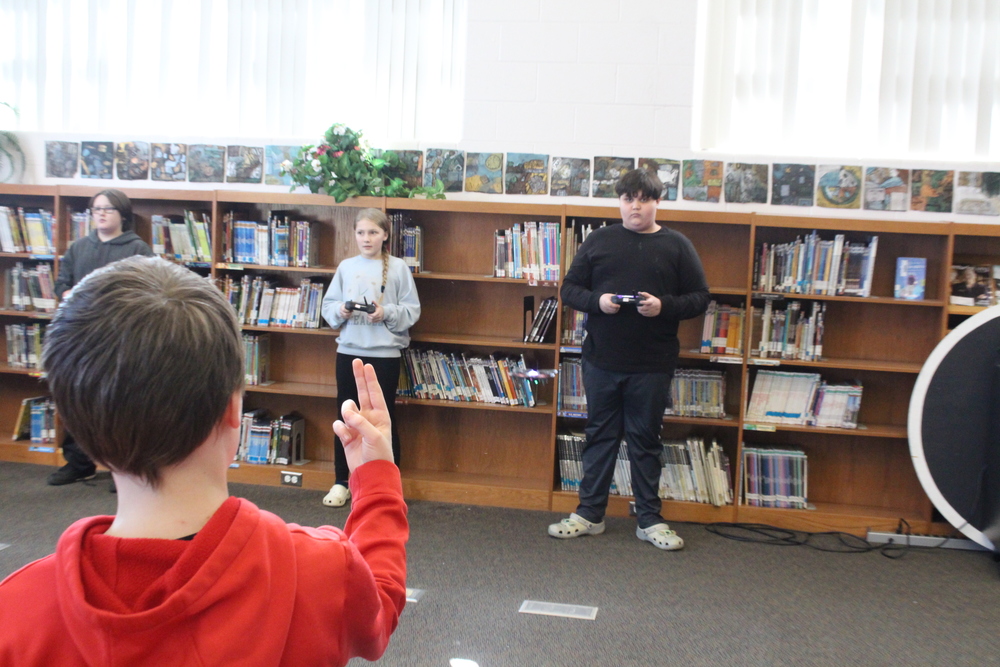
Working in small groups, students had to create hand signals that they’d use to navigate the drones with one student serving as the pilot and the other as the air traffic controller. In fact, the “I Can” statement posted in the library was “I can communicate with an air traffic controller.” They were tasked with creating signals for “take-off,” “throttle up,” “pitch forward,” and a variety of other terms.
“A part of being able to use technology is communicating appropriately and getting the right signals across so whoever is using the technology, flying the drone, can do so successfully,” May said.
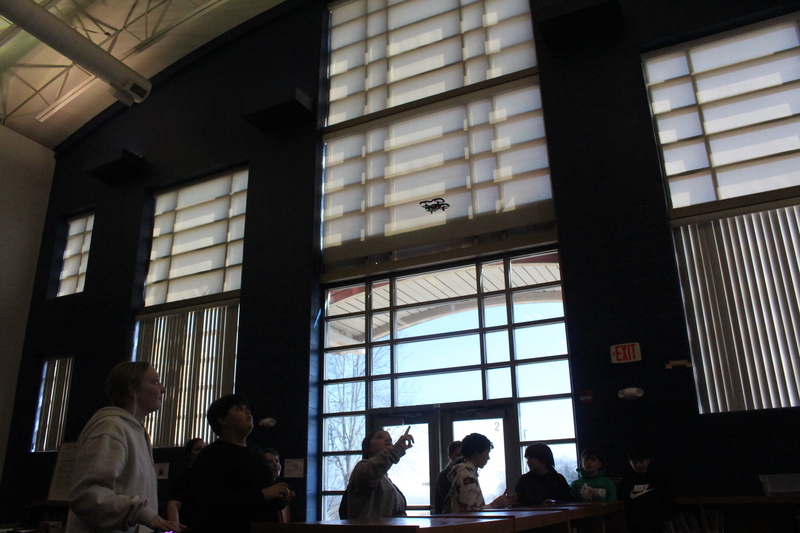
Taking turns, groups of students made their way to a large open area in the back of the library. A row of students holding the remotes lined one wall facing their partners who were serving as the air traffic controller. Between them, sitting on the floor, were the drones. At the traffic controllers signal, the drones whirred and lifted and before moving and turning based on the hand signals delivered to the pilots before landing where they began.
The first round of flights consisted of making simple maneuvers, but during the next round, students had to navigate the drones forward and attempt to land on a bookshelf, with some doing so successfully and others falling a bit short.
When she first received them, May said it took a while to acclimate herself to the kits and how to go about using them with students.
“I will admit that I don’t play video games so I’m not good with joysticks, but I had to do all the prep to get them synced with their controller,” she said. “I practiced the take off and landing, but I didn’t put myself through all the paces [...] There was a big learning curve for me to use all the correct flight terminology, too.”
Her students also had a lot to learn before taking the controls.
May said she started with what she calls “dry learning,” which involved going over basic background knowledge without touching the drones. She incorporated free lessons available from NASA to simulate the role of an air traffic controller, and students also completed lessons on computer coding to prepare for later on when they’ll fly the drones without the use of the remotes.
Part of the reason May requested the drones through the grant is because, as she put it, being able to operate that type of technology is “the wave of the future.”
“Our military uses [drones] and some of our students have talked about wanting to go into the military,” she said, adding that flying drones is now part of other careers whether it’s related to agriculture, package delivery, or examining difficult to reach areas for insurance purposes.
“This is a career path that covers a lot of things our students might be interested in,” she said. “They may have to know how to use these along with the other skills that we’re giving them.”
Another reason she wanted to add drones to her library is in the hopes that it may help students who compete at the annual Student Technology Leadership Program (STLP) competition.
The event now includes a competition involving flying drones through an obstacle course, and May’s hope is that one of her students is selected to compete.
But for now, she’s focused on giving students at MCMS an opportunity to learn with the drones. While so far she’s only used them during WIN time, her plan is to incorporate them in other classes she teaches and hopefully find ways to combine those lessons with other content. For example, May mentioned that 7th graders learn about calculating speed using distance and time.
“That’s something I think we could use the drones to do some experiments with so the students can try to calculate speed,” she said.
While it’s still very new, she said the drones have been a huge hit among her students.
“I like that they’re excited about it and that other kids are asking ‘When do we get to do it?’ If you can get kids excited to come to school, that’s my favorite part.”